IP for the IoT
September 21, 2015

What technology seems to get the most coverage these days (by a long shot)? It's the Internet of Things (IoT), of course. Adding fuel to the fire is a...
What technology seems to get the most coverage these days (by a long shot)? It’s the Internet of Things (IoT), of course. Adding fuel to the fire is an announcement by Synopsys, who now offer a comprehensive portfolio of IP that’s optimized to address the security, wireless connectivity, energy-efficient, and sensor-processing requirements for IoT applications like wearables, smart appliances, metering, and wireless sensor networks.
It’s pretty clear that re-purposing existing IP is neither efficient for particular tasks, nor is it sufficient for others. The IP should be re-architected and optimized to address the specific requirements for the IoT application at hand.
Available now, Synopsys’ DesignWare IP portfolio for the IoT includes power- and area-efficient logic libraries, memory compilers, non-volatile memory, data converters, wired and wireless interface IP, security IP, ultra-low power processor cores, and an integrated sensor and control IP subsystem. In addition, Synopsys’ embARC Open Software Platform offers online access to open-source and commercial drivers, operating systems, and middleware to accelerate development of application software.
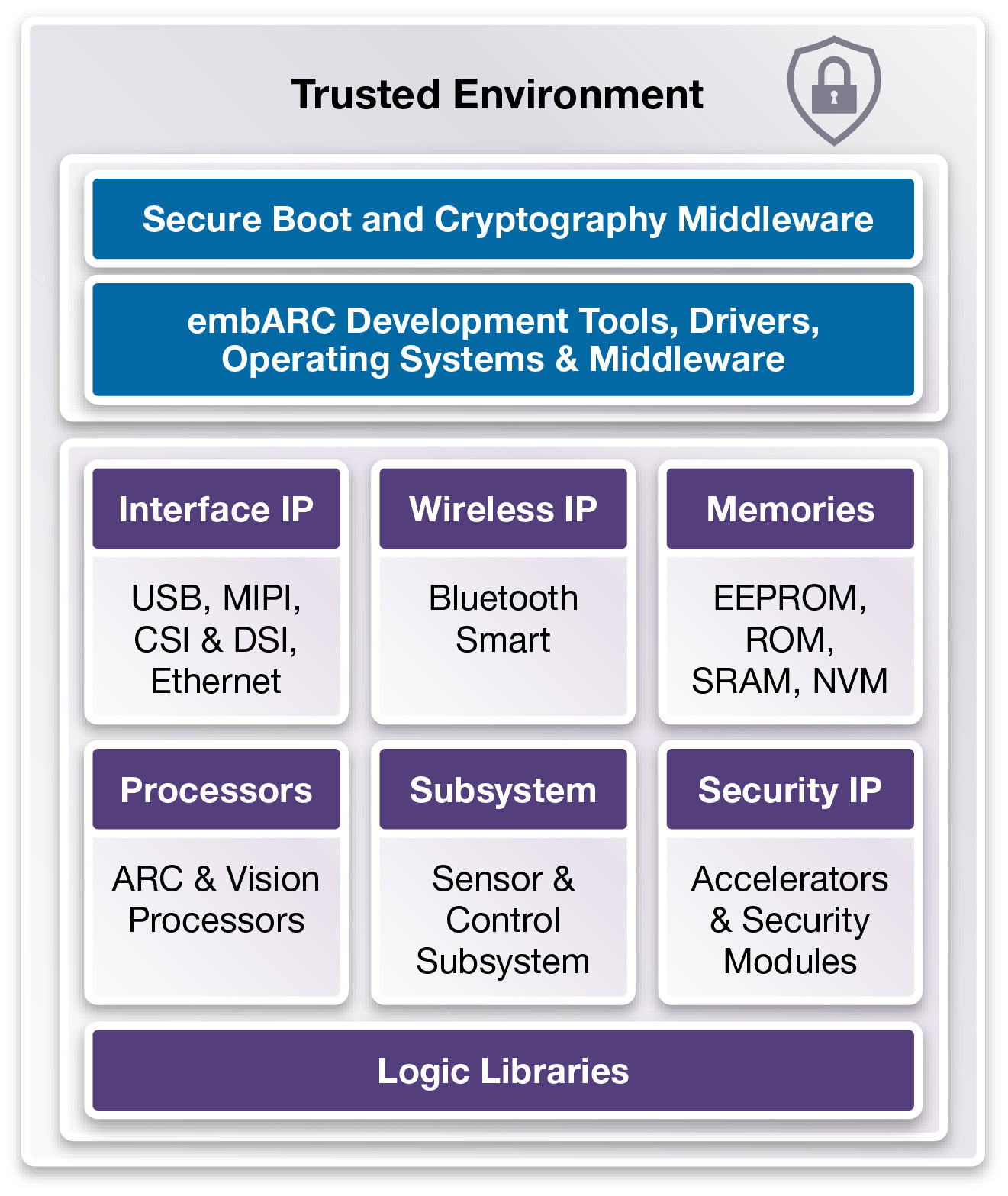
Click to enlarge.
The high-density logic libraries reduce power consumption while thick oxide logic libraries deliver low leakage for always-on functions. This is key for things like wearable that tend to be just that – always on. In addition, power- and area-optimized 12-bit and 14-bit SAR data converters, USB 1.1 and 2.0, MIPI CSI-2 and DSI, and non-volatile-memory IP enable implementation of sensor, data and connectivity functions. Performance can be tweaked thanks to the company’s highly configurable 32-bit DesignWare ARC embedded processor cores.
Other tools from Synopsys that can accelerate development include the MetaWare Development Toolkit and MQX RTOS. Support for the GNU tool chain and Linux kernel simplify the design process.

Rich Nass is a regular contributor to Embedded Computing Design. He has appeared on more than 500 episodes of the popular Embedded Executive podcast series, and is a regular contributor to the Embedded Insiders podcast.
Rich has been in the engineering OEM industry for more than 35 years, and is a recognized expert in the areas of embedded computing, Edge AI, industrial computing, the IoT, and cyber-resiliency and safety and security issues. He writes and speaks regularly on these topics and more.
Rich is currently the Liaison to Industry for the Embedded World North America Exhibition and Conference, and has held similar positions with the global Embedded World Conference and Exhibition.
Previously, Rich was the Brand Director for UBM’s award-winning Design News property. Prior to that, he led the content team for UBM Canon’s Medical Devices Group, as well all custom properties and events. In prior stints, he led the Content Team at EE Times, handling the Embedded and Custom groups and the TechOnline DesignLine network of design engineering web sites.
Nass holds a BSEE degree from the New Jersey Institute of Technology.
Podcast/Interview Coverage
IEEE Awards Frede Blaabjerg Talks EVS
Atmosic: Embedded Executive: Energy Harvesting Podcast
Article Coverage
Embedded AI Isn’t Enterprise AI, and That’s a Good Thing
Tear Down: Google Pixel Watch 4
Protect Your Home from Thieves and Floods
Advantech Teams With AMD To Maximize Performance at the Edge
View additional information